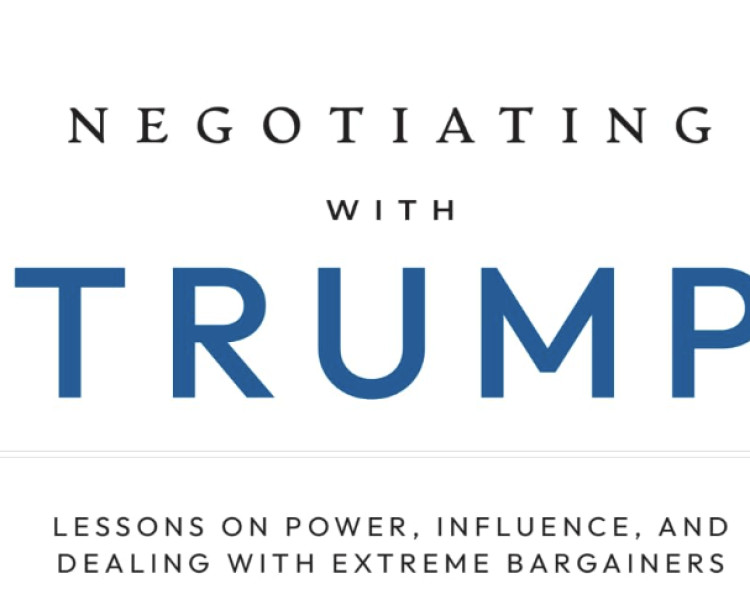
Negotiating with Trump: Lessons on Power, Influence, and Dealing with Extreme Bargainers is one of those rare books that manages to be both analytically sharp and immediately useful. It doesn’t lean on Trump as a personality for spectacle; instead, it treats him as a case study in modern power dynamics, stripping away noise to examine how influence actually operates in high-stakes environments.
What makes the book stand out is its discipline. Peter D. Johnston draws from decades of advisory work across corporations, governments, and public figures, and he translates that experience into a framework that is structured rather than speculative. The result is a clear breakdown of negotiation mechanics—anchoring, loss aversion, authority signaling, reciprocity—that feels grounded in real-world application rather than abstract theory.
The sections analyzing Donald Trump are handled with a steady, clinical focus. Donald Trump is used less as a subject of opinion and more as a lens through which to understand “extreme bargaining” behavior. Johnston is at his strongest when he dissects the strengths and blind spots of that style—showing not just why it can be effective in certain arenas, but also where it becomes self-limiting or destabilizing in prolonged negotiations.
Where the book really earns its value is in its transferability. It doesn’t stay confined to political or corporate arenas. Instead, it consistently pulls the reader back to everyday scenarios: difficult conversations, high-pressure decisions, and interactions with dominant personalities. The frameworks are practical enough to be used immediately, but sophisticated enough to reward readers who already understand basic negotiation theory.
The writing is confident and structured, with a focus on clarity over flourish. It avoids sensationalism, even when dealing with a figure as polarizing as Trump, and that restraint gives the analysis more credibility. Rather than telling the reader what to think, it equips them with tools to observe, interpret, and respond more effectively in their own negotiations.
Ultimately, this is not a partisan book and not a personality study dressed as strategy. It is a serious attempt to decode influence at its most visible and controversial edge—and in doing so, it becomes a surprisingly practical guide for anyone navigating pressure, power, or persuasion in modern life.