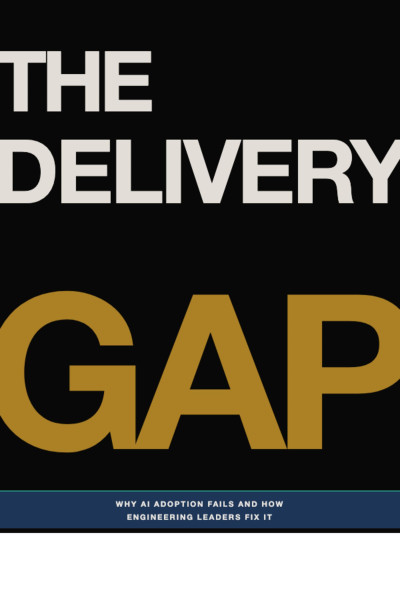
The Delivery Gap: Why AI Adoption Fails and How Engineering Leaders Fix It
Your team is writing more code than ever. Your incident rate is climbing too.
Pull request volume is up. Review quality is down. Senior engineers are spending their weeks proofreading AI-generated output instead of designing systems. The dashboards say productivity is up. The incident rate says otherwise.
This is the delivery gap: the growing distance between how fast your team can generate code and how fast your organization can verify that code is correct, secure, and aligned with what you intended to build.
Stripe ships 1,300+ AI-generated PRs per week — every one human-reviewed. Spotify's LLM-as-judge vetoes 25% of agent sessions. These companies are not faster because they adopted AI. They are faster because they built the verification infrastructure to make AI output trustworthy.
The Delivery Gap shows you how to build that infrastructure.
Inside:
• The Verification Triangle — metrics that tell you whether your verification is keeping pace with your generation velocity
• Six-tier quality gates — from static analysis through behavioral monitoring, each catching failure classes the tier below cannot see
• The Capability Ladder — seven levels of organizational readiness, from experimentation through full agentic operations
• Eight decisions — an implementation sequence with completion criteria, starting from wherever you are
• The Conversation — six questions your leadership will ask about AI governance, and how to answer them with data
• Case studies — what Stripe, Spotify, Webflow, Dropbox, and Airbnb actually built (not what vendors claim)
This is not a book about prompting. It is a book about what happens after the code is generated.
For CTOs, VPs of Engineering, Directors, and Engineering Managers responsible for AI adoption.
- Bookmark
- Comment
- Share