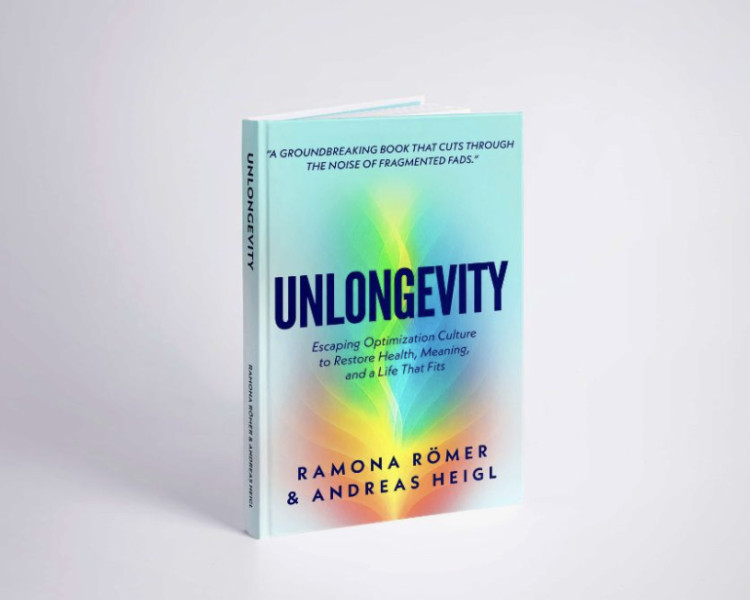
The pursuit of a longer life has become increasingly intertwined with the idea that we should always be doing more. More supplements. More testing. More tracking. More technology. More interventions. Unlongevity: Escaping Optimization Culture to Restore Health, Meaning, and a Life That Fits by Ramona Römer and Andreas Heigl takes a step back from that increasingly complicated landscape and asks a deceptively simple question: What if more is not always better?
Drawing from years of work with individuals seeking better health, Römer and Heigl make the case that longevity cannot be reduced to numbers, biomarkers, diagnoses, or a collection of health interventions. Their approach recognizes that people are different, and that the path toward better health can be shaped by biology as well as relationships, emotions, responsibilities, life circumstances, purpose, and the particular stage of life a person is experiencing.
One of the book's most compelling ideas is its examination of optimization culture. The desire to improve one's health is hardly a problem in itself. The problem arises when improvement becomes an endless pursuit, with every new study, supplement, diagnostic tool, or technology creating another reason to feel that something else needs to be added. Unlongevity explores how that mindset can turn something intended to support life into another source of pressure.
The authors illustrate this particularly well through the story of a woman who arrived with more than sixty supplements. Each choice had seemed reasonable on its own. Taken together, however, the collection had created a level of complexity that made it difficult to determine what was actually helping. It is an effective example of the larger argument: health is not necessarily improved by accumulation.
The book's five-axis framework further develops this perspective by encouraging readers to look beyond biology alone. Rather than treating health as a collection of isolated systems, Römer and Heigl emphasize the relationships between different dimensions of a person's life. Their argument is that biological changes may be the visible expression of deeper patterns that have been developing for much longer.
What makes Unlongevity particularly timely is that it does not reject modern science or technological progress. Instead, it asks readers to become more thoughtful about how those advances are used. Artificial intelligence, advanced diagnostics, continuous monitoring, regenerative medicine, and other emerging technologies can offer extraordinary possibilities. But having more possibilities does not necessarily mean every possibility belongs in every person's life.
At its best, the book encourages readers to replace the question "What else should I be doing?" with a more personal one: "What genuinely belongs for me at this stage of my life?"
That shift gives Unlongevity its strongest message. Longevity is not presented as the ultimate destination. A longer life has value because of what happens within it: the ability to connect, contribute, love, remain curious, and experience the people and moments that give life meaning.
Unlongevity ultimately offers a welcome counterpoint to the pressure surrounding modern wellness culture. Rather than encouraging readers to chase every new health trend, Römer and Heigl make a case for greater clarity, better timing, and a more individual understanding of what health actually means. For anyone who has ever felt overwhelmed by the endless list of things they are supposedly supposed to do for their health, the book offers a different possibility: perhaps living better does not always require doing more.