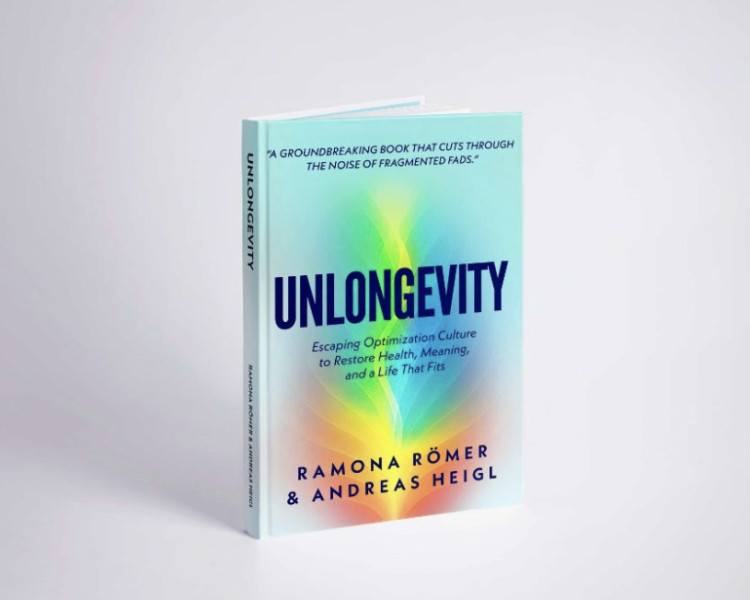
For nearly two decades, the team behind *Unlongevity* has worked at the intersection of health, longevity, prevention, diagnostics, regenerative medicine, and emerging approaches to human health. Their work began long before longevity became a cultural buzzword, when conversations around aging were more often framed around anti-aging and prevention. Today, the field has expanded dramatically, offering people more information, technologies, treatments, and choices than ever before.
But with those possibilities has come a new challenge: knowing what actually belongs to us.
*Unlongevity* questions the idea that there is one universal formula for aging well. Rather than treating health as a checklist of interventions, the book asks readers to consider the individual behind the data, recommendations, routines, and increasingly sophisticated tools available to them. Its central question is deceptively simple: What does this individual need at this particular moment?
In this conversation, the authors explore why more information does not necessarily mean more clarity, why healthy aging cannot be reduced to following the right rules, and why the most useful question may not be what more we should be doing, but what genuinely belongs to us.
## What inspired you to explore the science of longevity, and what surprised you most in your research?
Our relationship with what is now called longevity goes back almost two decades, to the beginning of our work at VIMED CELL. At the time, “longevity” was not yet the cultural buzzword it is today. There was anti-aging, initially often associated with appearance and later increasingly with biological aging, and there was prevention: trying to identify risks early and maintain good health for longer.
The terminology has changed, and so have the possibilities. Today longevity encompasses an enormous landscape of diagnostics, regenerative medicine, technologies, interventions, research, and approaches from around the world. Healthspan has also become an important part of the conversation, reflecting the recognition that adding years alone says very little about the quality of those years.
But the question at the center of our work has actually remained remarkably consistent: What does this individual need at this particular moment?
Some people come to us because something is wrong and they want immediate help. Others are already in excellent health and want to understand how to preserve and support that health. We never see those as reasons to apply the same protocol to everyone.
One of the biggest changes we have witnessed over the years has been health empowerment. When we started, people were much more dependent on professionals to tell them what was happening and what they should do. We felt very early that people needed to become active participants in their own health.
That empowerment has happened on a scale few of us could have imagined. People now have access to extraordinary amounts of information and to health possibilities from virtually anywhere in the world. At the same time, the possibilities themselves have multiplied enormously.
What has surprised us is that our ability to access health information has developed much faster than our ability to navigate it.
More information has not automatically created more clarity. More intervention has not automatically produced better outcomes. Something can work exceptionally well for one person and not belong to another at all. And over the years, we have repeatedly seen that not everything influencing a person's health can necessarily be understood through biology or what we are currently able to measure.
In that sense, Unlongevity did not begin with us deciding to research longevity. It grew out of almost two decades of working within this evolving field and watching the challenge change: from gaining access to possibilities to understanding how to navigate them.
## What does the term “unlongevity” mean, and how does it challenge conventional thinking about aging?
We chose the word Unlongevity because we wanted to interrupt the automatic assumption that longer is always the only question.
We absolutely believe in supporting health and longevity. But the conversation has become heavily focused on how many years we can add and what we can do to influence that number. The growing emphasis on healthspan already reflects an important realization: living longer tells us very little if we don't also consider how those years are experienced.
Unlongevity takes that question further.
For us, health cannot be understood only through biology or through what can be measured. A human being is more complex than that, and two people with similar data may need completely different things.
Health also does not work like a project plan. We cannot simply complete interventions A, B and C and assume that this guarantees a particular outcome or a certain number of years.
Today we have extraordinary possibilities-information, treatments, technologies, different approaches and knowledge from around the world. That is incredibly empowering. But a new recommendation does not automatically create a new responsibility. What works beautifully for one person may not belong to another.
So Unlongevity brings the individual back to the center. Instead of continually asking, “What else should I be doing?”, it asks a different question:
“What actually belongs for me?”
That is the challenge Unlongevity brings to conventional longevity thinking: longevity should begin with the individual, rather than with the method.
## What are the biggest misconceptions people have about getting older?
One of the biggest misconceptions is that aging is mainly a process of losing what we once had.
Aging certainly brings change, and some of those changes can involve genuine loss. We don't want to romanticize that. But change and loss are not the same thing.
When we are young, we tend to look at the next stage of life with curiosity. Children often cannot wait to become older because they associate the future with possibility: what they will be able to do, where they might go, who they might become. At some point, that relationship with age often reverses. Instead of looking ahead with curiosity, we begin looking backwards, comparing ourselves with an earlier version of who we were and trying to preserve it.
The difficulty is that we have very established ideas about what younger life should contain-education, career, relationships, family, achievement, discovery-but much less imagination around what later stages of life might contain. If we don't have a picture of possibility, it becomes very easy to define getting older mainly by what is no longer there.
Yet experience itself can open possibilities that were not available earlier. We may understand ourselves differently. Relationships can deepen or change. Things that once seemed enormously important may lose their significance, while something we barely noticed before becomes meaningful. Our purpose may remain the same while the way we express it takes a completely different form.
And there is no universal way to age. Two people can be exactly the same chronological age and have completely different health, energy, experiences, circumstances, ambitions, and lives. Age alone tells us remarkably little about what someone's life should look like.
Maybe one of the most valuable things we can carry with us from childhood is that curiosity-not wishing to be older or younger, but enjoying where we are while still being open to what life may show us.
Getting older does not have to mean becoming a lesser version of who we used to be. It means entering a different stage of life, one we may not fully understand until we actually live it.
## How much control do our daily habits actually have over how we age?
Our daily habits can influence how we age, sometimes enormously. But influence and control are not the same thing.
Health does not work like a project plan where, if we complete the right actions in the right order, we can guarantee a particular outcome. We are influenced by our biology, environment, experiences, relationships, emotional patterns, energy, purpose, circumstances outside our control, and other influences we may not even fully understand. Two people can follow very similar routines and still experience very different outcomes.
There is another aspect that we think has become increasingly important: where those habits actually come from.
Today, it is very easy to outsource decisions about our health. A friend starts a particular diet, someone we follow on social media has an impressive morning routine, an expert recommends a supplement, or our watch tells us how we slept. Before long, we can build a life around other people's answers without asking whether those answers genuinely fit us.
The more we look outside ourselves, the easier it can become to lose our own sense of what feels right, what our body or intuition may be communicating, and what actually serves the life we are living.
Expertise, information, and data can inform our decisions without replacing our relationship with ourselves.
And this is why the language of control can become problematic. If we believe that the right habits allow us to control how we age, then illness or an outcome we did not want can begin to feel like evidence that we failed-that we ate incorrectly, exercised incorrectly, didn't manage ourselves well enough, or somehow missed the right intervention.
Our choices matter. But healthy aging is not a reward for having followed all the rules correctly. It is an ongoing relationship with ourselves, in which outside information can guide us without becoming a substitute for knowing ourselves.
## Which lifestyle factors have the strongest scientific evidence for supporting a longer, healthier life?
There is a great deal of research trying to rank which lifestyle factors have the greatest influence on longevity. But our work has led us to approach the question differently.
Imagine the individual as an orchestra. Many different instruments are playing at the same time, and health depends partly on how they interact. If something sounds out of tune, the answer is not necessarily to make all the other instruments play louder. We first need to understand where the imbalance is coming from.
The same applies to health. For one person, the area that needs attention may be biological. For another, something happening emotionally, energetically, within their environment or relationships, or in the way they are living in relation to their deeper purpose may be far more relevant at that moment. And changing one part can influence several others.
This is why looking only for the lifestyle factor with the “strongest scientific evidence” can be limiting. Scientific research can tell us important things about populations and measurable outcomes, but a human being is influenced by much more than what can be isolated and measured. There are also personal and ancestral imprints, energetic influences, and other dimensions of human experience that do not fit neatly into conventional scientific evaluation.
And the most important influence is not necessarily the same throughout someone's life. What needs attention today may be completely different from what needed attention ten years ago.
So rather than asking which lifestyle factor ranks highest, we ask where this particular individual needs support now.
The goal is not to optimize every instrument. It is to understand what is out of tune, what belongs, and what may help the whole person come back into greater harmony.
## How do stress, sleep, and social connections influence the aging process?
They can all influence how we feel and function, but their meaning is much more individual than simply saying that stress is bad, eight hours of sleep is good, and more social connection is better.
Stress is a good example. We tend to speak about stress as though it is automatically negative, but some forms of stress can energize us, challenge us, and help us grow. What wears someone down may be something quite different: living continuously in a way that does not fit who they are.
Someone may spend years trying to succeed in a role that looks desirable from the outside but is completely wrong for them. We often use the example of everyone wanting to become the general manager, when some people may be far happier and more fulfilled as the expert. The title is not the point. The fit is.
We also increasingly fill every available moment. There is always another message to answer, podcast to listen to, workout to complete, or something we could be improving. We have almost forgotten how to have a moment with no agenda behind it. If a moment without an agenda immediately makes us uncomfortable or guilty, that can tell us something too.
Sleep can also be a messenger rather than simply another target to optimize. If someone is sleeping poorly, the answer may not begin and end with improving a sleep score. What is happening in that person's body and life? What is keeping the system from settling?
Relationships work in a similar way. A large social network is not automatically healthier than a small one. Some relationships create belonging, joy, and energy; others can require us to continually suppress ourselves or remain in situations that wear us down.
For us, the common thread is not perfect stress management, perfect sleep, or a prescribed amount of social connection. It is whether the way we are living fits the person we actually are. When we continually move away from that center, the effects can eventually show up in many different places-including how we sleep, how we feel, how much energy we have, and how our health develops over time.
## What emerging developments in longevity research are worth watching, and which claims should people approach cautiously?
There are many fascinating developments in longevity, but we don't think there is one particular trend that everybody needs to be watching.
That idea itself reflects something we question in Unlongevity: the assumption that because something new is emerging, all of us need to pay attention to it or eventually incorporate it into our lives.
Different people are interested in very different aspects of health. Someone may be fascinated by biohacking, biomarkers, regenerative medicine, or the latest technological developments. Another person may already have spent years exploring those areas and no longer be interested in every new intervention that appears. Someone else may be drawn toward approaches that understand health through perspectives that cannot necessarily be captured through conventional scientific measurement.
None of these people needs the same “next big thing.”
Scientific research will continue to create extraordinary possibilities, and we follow many of those developments in our own work. But scientifically measurable approaches are not the only perspectives we consider. There are also approaches centered much more directly around the individual and their particular experience that cannot necessarily be standardized, reproduced, or measured in the same way. These approaches should be understood within the context from which they come rather than being forced into a scientific framework that may not be capable of capturing what they are addressing.
At the same time, the word “science” itself should not make us stop asking questions. Research findings have limitations, early results can be overstated, and by the time a nuanced finding becomes a headline, product, or marketing claim, it may sound much more definitive than the original research ever was.
For us, what is worth watching is therefore not one particular intervention or trend, but how our ability to navigate all these different possibilities develops alongside the possibilities themselves.
We can remain curious about what is emerging without feeling compelled to chase every development. The important question remains the same: Does this genuinely belong to this individual, at this particular moment?
## What are three practical, evidence-based steps people can start taking today to support healthy aging?
This question actually illustrates one of the reasons we wrote Unlongevity. People are already surrounded by lists of the three, five, or ten things they should be doing to live longer. If we add another three universal steps, we contribute to the same accumulation of advice.
Over time, people can build an enormous collection of health responsibilities: eat this way, exercise according to this protocol, sleep this many hours, track these biomarkers, take these supplements, manage stress correctly, and make sure you are not missing whatever comes next. Each recommendation may have a rationale behind it, but together they can create the impression that health is a project we can complete successfully if only we follow enough of the right instructions.
Our experience has taken us in a different direction.
Instead of giving three new actions, we would start with one question: Why am I doing what I am already doing for my health?
Look at what has accumulated around you. Which choices genuinely came from understanding yourself? Which were introduced because they addressed something you actually needed? Which are still serving you? And which came into your life because an expert, friend, study, device, or person you follow told you they were important?
This is not an invitation to do less. Someone asking these questions may discover that they need much more support than they are currently receiving. They may need further investigation, another intervention, a different perspective, or something they have never considered before. Someone else may realize that they are doing a great deal that no longer belongs to them.
And the answer does not have to come exclusively from what can be demonstrated through conventional scientific evidence. Health can be influenced by dimensions of the individual that are not easily measured on paper. What matters is developing enough discernment to understand what genuinely belongs rather than continually outsourcing that decision.
So if we had to offer three starting points, they would not be another diet, exercise protocol, or supplement. If we had to reduce it to three, they would be:
Understand where you are. Listen to yourself. Then decide what genuinely belongs.
The individual comes first. The action follows from there.