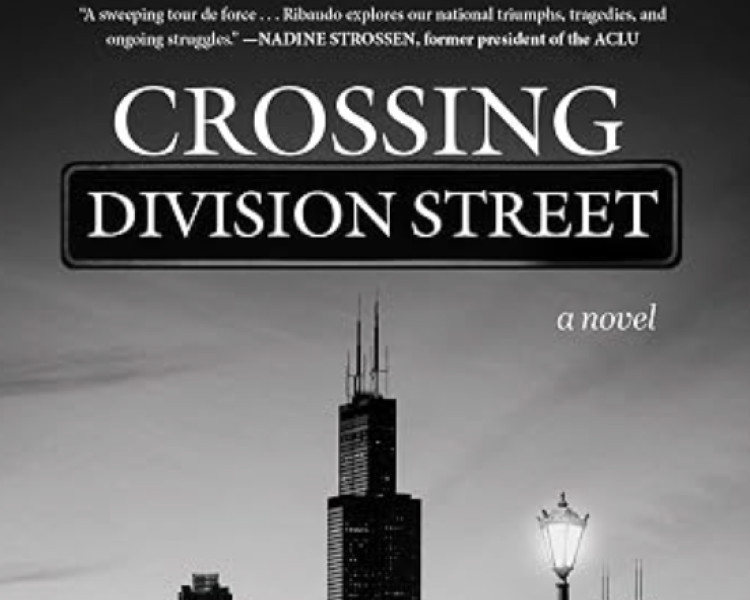
Rebecca Chamian Ribaudo’s debut novel, Crossing Division Street, opens with a decision that immediately places its protagonist in a difficult position.
It is July 1999, and Sidone Russo, a successful Chicago attorney, is stopped at a red light in Cabrini-Green when a young girl suddenly gets into her car and begs her to drive away. Sidone does. What follows draws her into a situation that forces her to confront a part of her family history she has spent much of her adult life keeping at a distance.
From that opening, Ribaudo builds a novel about the complicated relationship between the lives we create for ourselves and the histories we inherit.
Sidone has worked hard to establish an identity independent of her family’s past. But the events surrounding the girl bring that history back into her present, eventually forcing Sidone to consider what she is willing to reveal about herself and what she is willing to risk in order to help an orphaned child.
The story unfolds across two timelines, moving between Sidone’s life in 1999 and the experiences of the generations who came before her. Spanning approximately a century and four generations, the novel connects one family’s story to the larger history of Chicago.
That history includes the area once known as Little Sicily and Little Hell, as well as the neighborhood that later became associated with Cabrini-Green. Ribaudo uses these changing Chicago landscapes to show how communities evolve, disappear and are remembered differently over time.
The novel also places its characters against some of the defining events of the twentieth century, including immigration, racial violence, riots, wars and political assassinations. These events are not simply historical markers. They shape the circumstances in which the characters live and influence the choices available to them.
For Sidone, those questions become especially urgent when her professional life intersects with a high-profile adoption case. Her background could potentially help her, but using an identity she has deliberately kept private would mean crossing a line she has spent years establishing for herself.
The conflict is not simply about whether Sidone should disclose a secret. It is about whether the person she has become can be separated from everything that came before her.
That question gives the novel much of its emotional tension. Sidone’s family history is neither something she can completely embrace nor something she can simply erase. The more she learns about the generations before her, the more complicated her understanding of herself becomes.
Ribaudo is particularly interested in the idea of inheritance. Families pass down more than property or physical characteristics. They pass down names, traditions, beliefs, memories and stories. Sometimes they also pass down information that has been deliberately concealed.
For Sidone, that inheritance conflicts with the independence she has built into her adult life. She wants to define herself on her own terms, yet the circumstances surrounding the adoption case demonstrate how much the past can continue to matter.
The novel’s Chicago setting reinforces that idea. Places change, neighborhoods are renamed and communities move or disappear, but the histories attached to those places do not necessarily disappear with them. By following one family through those changes, Crossing Division Street gives its broader historical themes a personal dimension.
Identity is another recurring concern. The novel considers the ways people define themselves, as well as the ways society defines them through race, ethnicity, nationality and religion. Those categories can influence how characters are treated and, in some cases, whether they feel safe enough to claim an identity openly.
The title itself reflects the novel’s interest in boundaries. Sidone is navigating divisions between past and present, family and independence, private identity and public identity. The characters who came before her faced their own divisions, shaped by the time and place in which they lived.
Rather than treating history as something neatly contained in the past, Ribaudo shows how earlier generations continue to influence those who follow them. A family can carry the consequences of decisions made long before its newest members were born.
That makes Crossing Division Street both a family story and a story about a changing city. Its historical scope allows Ribaudo to explore how individual lives intersect with larger social forces, while its focus on Sidone keeps those questions grounded in a very personal dilemma.
At its center is a woman who has spent years deciding who she wants to be, only to discover that understanding that identity may require looking more closely at where she came from.
Crossing Division Street will be published September 29, 2026, by Skyhorse.